

Tuesday, August 15, 2017



Wednesday, June 21, 2017
Nelson is 10!
It is so gratifying to get updates on our foster cats and kittens from their adopters. It's really special when you still get updates after ten years!
I’m including some pictures taken over the past few months of my boy and his 4-year-old adopted sister, Lana Kitty Pierson, as well. Lana is a little petite Torbie, also from Feline Rescue.
I’ve also included a photo of Alvie, Nelson’s biological sister who lives at Calhoun Pet shop. I still visit her and she is doing well. Every time I look at her all I can see is that her face is just like Nelson’s!
I was hoping that when I adopted Lana that Nelson would be tolerant of her but that never worked out. As you know Nelson has some serious behavioral problems due to a neurological issue so I knew going into the adoption of Lana that it may not work. I was concerned that Lana would not get the life she deserves nor would he however I was wrong. Both seem very content, affectionate, and happy so life is good for them and me.
I adopted Lana from another Feline Rescue foster caregiver, she was the mother of 5 beautiful babies. 4 out of the 5 had already been adopted and one of her babies, Frankie, was still living with her. Lucky for me, Lana was available and, knowing that Mama cats don’t get adopted as readily as kittens, I wanted to give her a good home. She is very petite and I cannot conceive how she managed to carry 5 kittens.
Lana is very affectionate and kind. She is also very friendly to all who visit and loves to watch birds, bunnies, and squirrels, just like Nelson.
Nelson still has to eat raw rabbit only and take Prozac, but his issues are now under control, so he is happy in his own skin and able to give and receive comfort and love. He is very bonded to me and very routine-oriented. If his routine gets interrupted he gets anxious and irritated, he lets me know this by being very vocal. He has always been very vocal and enjoys telling me just how he feels about things.
He brings a smile to my face every day and has become quite a snuggle bug. I feel very fortunate to have both him and Lana in my life.
 |
| NELSON AXEL |
UPDATE FROM ADOPTER:
Nelson Axel celebrated his 10th year with me in his forever home. He was born 10 years ago yesterday and, thanks to you and Feline Rescue, I’ve had the pleasure of his company all these years.I’m including some pictures taken over the past few months of my boy and his 4-year-old adopted sister, Lana Kitty Pierson, as well. Lana is a little petite Torbie, also from Feline Rescue.
 |
| LANA KITTY PIERSON |
 |
| ALVIE |
Nelson still hates Lana :-(, but they live in separate spaces in my home and both are happy and thriving.
I was hoping that when I adopted Lana that Nelson would be tolerant of her but that never worked out. As you know Nelson has some serious behavioral problems due to a neurological issue so I knew going into the adoption of Lana that it may not work. I was concerned that Lana would not get the life she deserves nor would he however I was wrong. Both seem very content, affectionate, and happy so life is good for them and me.
 |
| NELSON |
Lana is very affectionate and kind. She is also very friendly to all who visit and loves to watch birds, bunnies, and squirrels, just like Nelson.
 |
| LANA |
 |
| NELSON |
 |
| NELSON |
Thanks to you and Feline Rescue for all you do to help our feline friends. What a bunch of caring and compassionate folks you are!
Tuesday, June 20, 2017
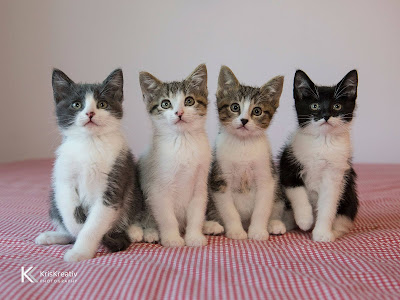
Photographing Kittens - the Group Challenge
Photographing a cat can be difficult (because they're cats!) and photographing a silly, energetic kitten is even more of a challenge. My own foster kittens' photos are either blurs or a bunch of kittens sleeping.
Kris Kaiser (KrisKreative Photography), has been taking amazing photos of our cats and kittens and has taken on the advanced challenge of photographing groups of wide awake kittens. It's almost magical watching her capture those moments, engaging the kittens and getting them to sit together. We're very thankful to have her sharing her skills with us to help our cats and kittens not only get adopted faster but to provide wonderful visual memories to our foster volunteers.




Check our website for our list of available cats and kittens and for more information about adopting through Feline Rescue.
Kris Kaiser (KrisKreative Photography), has been taking amazing photos of our cats and kittens and has taken on the advanced challenge of photographing groups of wide awake kittens. It's almost magical watching her capture those moments, engaging the kittens and getting them to sit together. We're very thankful to have her sharing her skills with us to help our cats and kittens not only get adopted faster but to provide wonderful visual memories to our foster volunteers.
Bella, Jax and Izzy

Dimitri, Sonia and Alexei

Tortellini, Rotini, Ravioli and Macaroni

Roy, Clarence and Esther

The Peanuts Gang

Porter, Liesl and Brigitta

Sashimi, Maki and Nori

Check our website for our list of available cats and kittens and for more information about adopting through Feline Rescue.
Monday, June 12, 2017

Sunday, June 4, 2017
June is Adopt-a-Shelter-Cat month

June is Adopt-a-Shelter-Cat month. A good reminder that Feline Rescue is a great place to consider when adding a feline companion to your household!
View our available cats and kittens >
There are approximately 5,000 animal shelters in the
country. Seven in ten cats in US shelters are
euthanized annually because there is no one to adopt them (ASPCA). This isn’t a surprising statistic considering
that an average non-spayed female can have 1-8 kittens per litter, 2-3 litters
per year, and that a single pair of cats and their kittens can produce as many
as 420,000 kittens in just 7 years (Fayette Humane Society).

Feline Rescue and other shelters offer variety: sleek/chunky,
gentle/sassy, young/senior, naughty/nice.
So many different colors and shapes, so many different personalities. Some cats who are “perfect”, some who are sight-impaired,
some who are deaf, and some with FIV or Felv. So many wonderful cats ready for loving homes where they can offer so
much in return. Shelters offer such
diversity of cats that really, there is a cat for everyone. 

Besides sheer diversity, other benefits are derived from adopting shelter cats. Staff know a cat’s personality and can discuss whether or not an adoption can be a good fit, and they can offer advice on cat behavior. Feline Rescue and many other shelters spay or neuter cats and provide veterinary care to ensure their cats are healthy when adopted. Many shelters also willingly accept cats back if an adoption doesn’t work out.

A win-win-win situation: An overabundance of cats / shelters where the focus is to place as many cats as possible in good homes / people adopting from shelters.
A compassionate and wise solution when considering a new
family cat: Adopt a Shelter Cat. Save a life, make space for another cat, and enhance
your life.


Feline Rescue's adoption center is located at:
593 Fairview Ave N, St. Paul, MN 55104
593 Fairview Ave N, St. Paul, MN 55104
HOURS:
Monday – Friday: 10:00 a.m. – Noon and 6:00 p.m. – 8:00 p.m.
Saturday and Sunday: 10:00 a.m. – 2:00 p.m.

Photo credit: Mandy Dwyer - Glimpses of Soul Photography
Sunday, May 21, 2017
Because we could all use a little sunshine right now, here's an update on "Ray of Sunshine"

Ray of Sunshine was a stray, live-trapped for TNR (Trap-Neuter-Return) by a Feline Rescue volunteer. Once in our care, volunteers recognized something special about this little girl. She didn't have plans to be a feral cat. She just had to come inside. Ray's foster mom called her Ray of Sunshine (ROS) because of the joy she brought into the house and to other cats around her. Although she was extremely shy with people, ROS was a magnet for other cats. She loved to snuggle. And she really loved to play!
ROS moved from her foster home to the adoption room at Woody's Pet Food Deli and was adopted to live with "Buddy", another cat who had just lost his feline friend and needed a companion. ROS's family was very patient and attentive to her need to warm up at her own pace. Sara recently sent an update on ROS, who is now called Rey:
Thought you and Rey's former foster might like some of the more recent pictures of her.
She's almost always with her Buddy (our orange cat's nickname) and she loves snuggling with him. If he changes rooms and she can't find him, she'll start crying and he'll get up and come find her. Aside from that, she's fairly quiet except for mealtimes, when suddenly she's the loudest little high-pitched squeak you'll ever meet! Despite being wary of our beagle at all other times (usually just means she's perched on something, even if that something is only a foot high and she's at eye level with him!), food is enough of a motivator that she's crept right up to the dog while he's eating and debated helping herself. Hasn't taken that first mouthful yet, but it's going to happen one of these days!
She's regularly asking for pets these days and will allow herself to be picked up to move her from spot to spot. No snuggling in our arms yet, but from the progress she's been making that day will come. Our kitchen window overlooks the back yard with its rabbits, and I just put a bird feeder in. She loves it, especially when it's nice enough to open the window. The window in the cats' room faces the street, and the cats seem to enjoy watching all the humans pass by.


Thursday, April 27, 2017
Adoption Update: The Tippy Tuxies

 |
| Calvin on the day he came in for pictures |
 |
| Rosie |
A little bit about Cerebellar Hypoplasia
Feline cerebellar hypoplasia (CH) is a non-progressive, non-contagious neurological condition that results in walking and balance problems. A kitten is born with CH when her cerebellum, the part of the brain that controls fine motor skills and coordination, is underdeveloped at birth. Consequently, an underdeveloped cerebellum can result in underdeveloped or complicated mobility. CH cats are known for their “drunken sailor” walk, which is why they’re known endearingly as “wobbly cats.” Since the condition is non-progressive, it will never get worse — and in some cases, owners say that their cat became more capable over time [as they learn to adapt to their disability and develop muscles]. Source: lifewithchcats.com
Feline cerebellar hypoplasia (CH) is a non-progressive, non-contagious neurological condition that results in walking and balance problems. A kitten is born with CH when her cerebellum, the part of the brain that controls fine motor skills and coordination, is underdeveloped at birth. Consequently, an underdeveloped cerebellum can result in underdeveloped or complicated mobility. CH cats are known for their “drunken sailor” walk, which is why they’re known endearingly as “wobbly cats.” Since the condition is non-progressive, it will never get worse — and in some cases, owners say that their cat became more capable over time [as they learn to adapt to their disability and develop muscles]. Source: lifewithchcats.com
 |
| Daisy on the day we met |
When I started fostering
this trio, my goal was to get all of them adopted together. Rosie and
Calvin were extremely bonded, and although Daisy was more independent, I
thought it would be better for her to stay with her siblings. Although, I’m
pretty sure most of the foster volunteers were already placing bets about my
impending “foster fail,” I think the moment I knew was on August 9, when Paul
and TJ from the Engineer's Guide to Cats were at Feline Rescue on the day of the Cat Video Festival. I brought
the trio in for the open house, and I was being asked when they’d be available for
adoption. I didn't like the idea that they might be leaving me someday!
 |
| Paul and TJ with Calvin, Daisy and Rosie |
National Specially-abled Pets Day is May 3 so I wanted to share some information on what it’s like to live with
animals who would be labeled as “special needs.”
 |
| Rosie |
Cats with CH do require some
special considerations, but to what extent can vary from cat to cat. Even cats
in the same litter can be affected differently. The Tippy Tuxies had siblings
that were not affected at all. Calvin and Rosie walk and run pretty well, but
Calvin can’t jump at all, and Rosie can only jump a little bit. She’s good at
jumping up to the couch, for example, but the bed is a little too high so she
climbs. It helps that I have carpet thoughout most of my home. This gives them
traction and helps reduce their spills and also provide a little extra padding
for when they do fall. For Daisy, that carpet is essential because she needs it
for traction. She is not strong enough or balanced enough to walk very well on
slippery surfaces.
 |
| Calvin |
They have stairs to get up to the
bed and a tray under their water bowl to catch spills. Their litter boxes have
high sides and a low entry to make it easy to get in, but also for them to lean
against if they need to. I found a cat tower that has levels that are closer
together and easier for them to climb to the top, and also isn’t too high, so
that if they fall off (or jump from the top like Rosie does), they won’t get
hurt. And I try a little harder to find activities to keep them engaged.
Especially for Daisy who can’t burn energy by running chasing her siblings
around, it’s critical to find activities that help her develop muscle and keep
her mentally stimulated.
 |
| Daisy |
Walking still pretty hard for her, it takes all of her concentration to balance, take a step, and even just stand without support. It’s possible and even likely her walking skills will continue to improve over the next few months. I have hopes that she’ll be able to move around without tumbling over every few steps.
 |
| Daisy uses a wide stance to balance while standing and walking |
 |
| Rosie, Calvin and Daisy |
In honor of National Specially-abled Pets Day, May 3, please
spread the word about how truly
wonderful pets with “special” features can be!
Story and photos by Kris Kaiser
Subscribe to:
Posts (Atom)


